Triglav – Mountain and Symbol
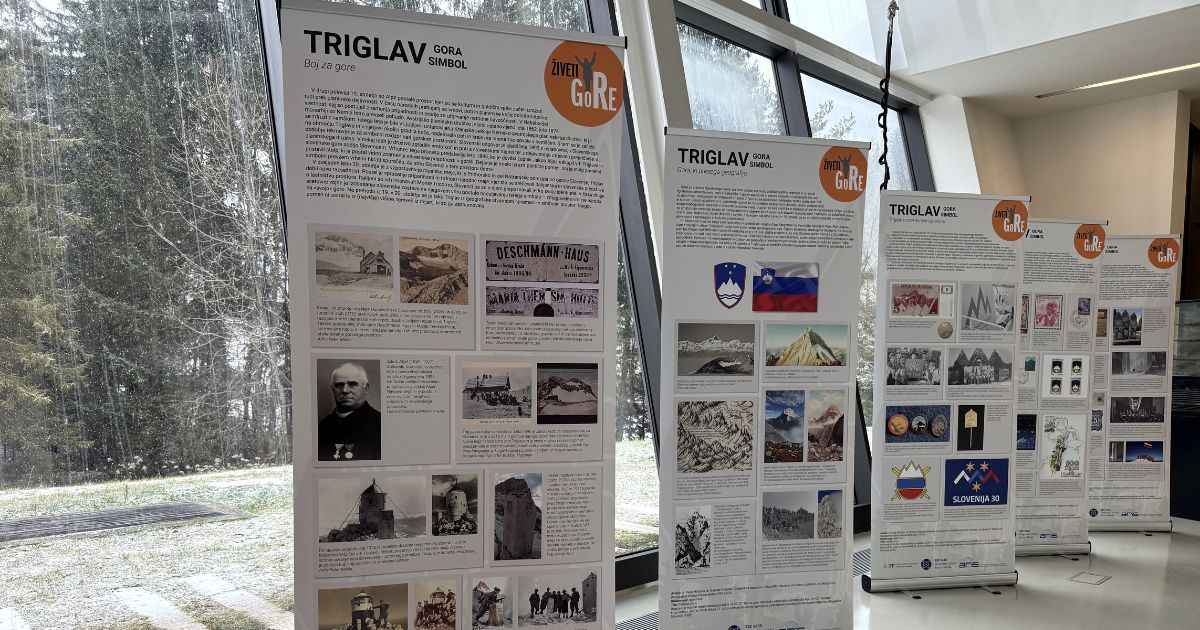
A new exhibition has arrived at the Slovenian Alpine Museum: Triglav – Mountain and Symbol. ☃
The exhibition tells the story of how Triglav evolved from the highest mountain in the Slovenian territory into the central national symbol of Slovenia. It starts from the gap between actual spatial realities and the self-image Slovenians hold. Although Slovenia has relatively little high-mountain terrain and almost no permanent settlement at high altitudes, the image of Slovenians as a mountainous, Alpine nation has become deeply rooted in the collective consciousness. In this process, Triglav assumed the role of a key reference point whose symbolic significance far exceeds the physical space it occupies. The exhibition shows that this role was not self-evident, but historically constructed.
In the second half of the 19th century, mountains became a space for expressing national identity. Trails, huts, names, and presence in the mountains were no longer merely part of mountaineering activity, but a means of asserting presence in space. Triglav emerged as a stage of symbolic competition, where national aspirations were realised through actions and interventions in the landscape – from the erection of Aljaž’s Tower to border disputes after the First World War and symbolic acts during the Second World War.
In the 20th century, Triglav entered the official symbols of the state. Its image appears in coats of arms, on the national flag, and later also within the European context. It became a constant element of political and visual identity, regardless of social and ideological changes.
Today, Triglav is encountered almost everywhere – in signs, logos, posters, and souvenirs. Rather than glorifying the mountain, the exhibition reveals the process through which a concrete place became one of the fundamental symbols of Slovenian identity.
The exhibition is the result of the research project “The Struggle for the Mountains: Slovenian National Appropriation of the Alps (19th–21st Century)”, led by Assoc. Prof. Dr. Peter Mikša (Faculty of Arts, University of Ljubljana) and co-funded by the Slovenian Research and Innovation Agency (ARIS).
Exhibition authors:
Dr. Peter Mikša and Dr. Božidar Flajšman (Department of History, Faculty of Arts, University of Ljubljana)
Dr. Matija Zorn (Anton Melik Geographical Institute, ZRC SAZU)
The exhibition is on view in the museum lobby until the end of March 2026. You are warmly invited to visit!